Mechanical Engineering
Helping You Bring Your Best to Mechanical System Design
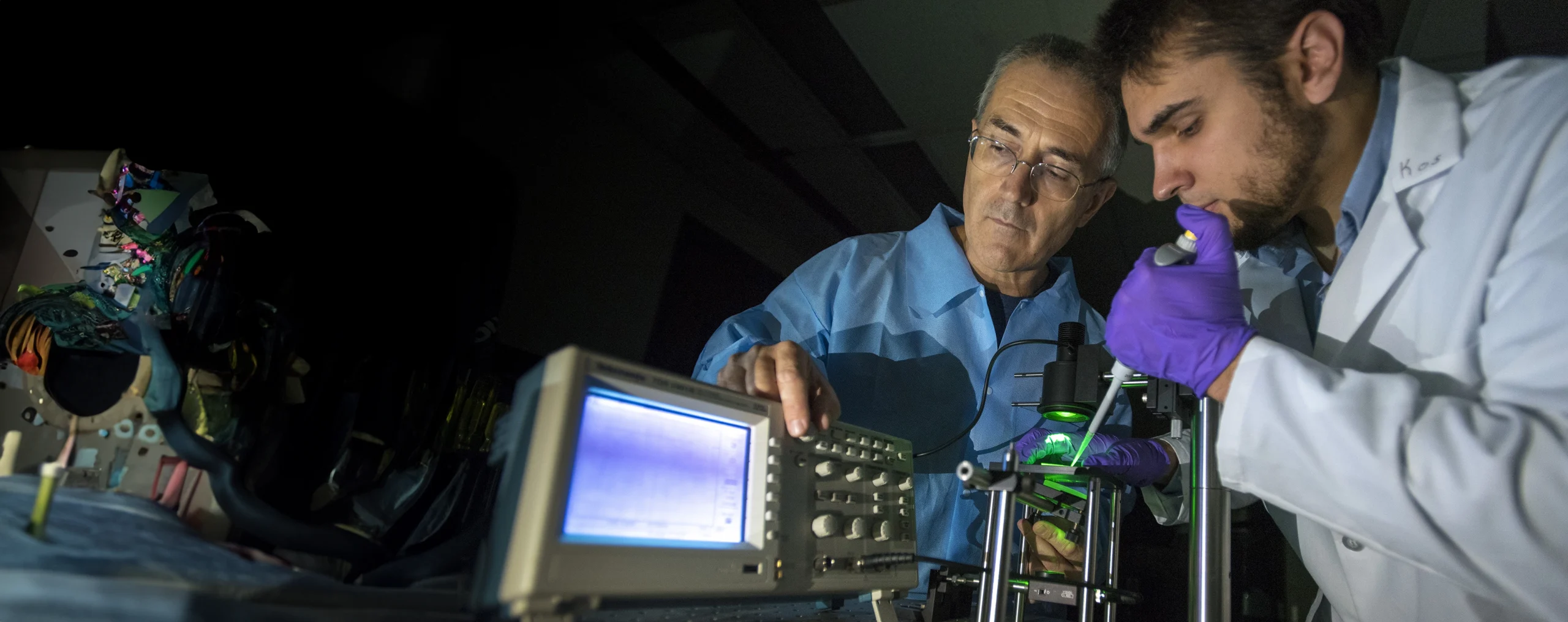
Mechanical engineering involves the analysis, design, manufacturing, and maintenance of mechanical systems. It encompasses a wide range of advanced topics, including the design and operation of innovative energy conversion devices, sensors, sensor networks, and process control. The program focuses on the development of advanced materials for the mechanical analysis of nanoscale and biological systems, as well as computer-aided design for highly engineered systems. The Master of Engineering (M.Eng.) in Mechanical Engineering program is a 30-credit online graduate degree that prepares graduates for significant roles in the mechanical engineering sector. You can choose from two tracks within the Mechanical Engineering concentration: Systems and Mechanics, or Thermal and Fluid Sciences.
Application Deadlines
FALL SEMESTER
July 15
SPRING SEMESTER
December 1
SUMMER SEMESTER
April 20
Acquire the skills you need to excel as a mechanical engineer
This program is offered through UConn’s School of Mechanical, Aerospace, and Manufacturing Engineering within the College of Engineering, and it features award-winning faculty members who are experts in their field. UConn’s engineering research, educational endeavors, and career-driven online course curriculum are closely tied to many international, high-tech companies having a strong interest in Mechanical Engineering disciplines, including Thermal and Fluid Sciences or Systems and Mechanics.
Thermal and Fluid Sciences Track
In addition to professional development skills, you will gain the knowledge and skills to:
- Understand advanced thermodynamics, including complex energy conversion, cycles, and system efficiency.
- Master advanced fluid mechanics principles, covering fluid behavior, viscous/turbulent flows, and conservation law application.
- Excel in advanced heat and mass transfer, encompassing conduction, convection, radiation, and mass transport mechanisms.
- Conduct multiphase system analysis, focusing on heat and mass transfer within multi-phase systems (e.g., boiling, condensation).
- Proficiently model, simulate, and analyze fluid flow using Computational Fluid Dynamics (CFD) software and methods.
- Understand combustion science, pollutant formation, and air pollution control systems.
- Design and optimize thermal and fluid systems for efficiency and performance.
- Develop and utilize computational models for the simulation of thermal-fluid phenomena.
View the M.Eng. Mechanical Engineering Plan of Study.
Systems and Mechanics Track
- Understand advanced solid mechanics and material behavior under various loading conditions.
- Perform finite element analysis (FEA) for complex structural, thermal, and vibrational problems.
- Analyze and control mechanical vibrations in dynamic systems.
- Apply principles of advanced dynamics to multi-body mechanical systems.
- Design and analyze control systems for diverse mechanical engineering applications.
- Optimize mechanical components and structures for performance, durability, and reliability.
- Conduct failure analysis to predict component lifespan and prevent mechanical failures.
- Utilize computational methods and software tools to solve complex mechanical problems.
Note: This 100% online M.Eng. concentration is not eligible for UConn visa sponsorship.
What Are they Saying?
Why Choose UConn?
Elevate Your Career with UConn’s Master of Engineering
The next step in your engineering career starts here. UConn’s Master of Engineering (M.Eng.) offers a flexible and accessible path to drive your career and expertise from a top-ranked institution, no matter where you are or where you go.
Advanced Engineering Careers
What will you do with your M.Eng. degree?
Driving engineering careers with a UConn M.Eng., our graduate programs provide the advanced knowledge and skills sought after by employers across many sectors. Graduates are well-prepared for roles in areas such as product development, project management, research and development, technical consulting, and specialized engineering positions within industries ranging from manufacturing and technology to infrastructure and energy.

Student’s Name
Vestibulum et lectus mauris. Vestibulum cursus, lectus ac sodales commodo, nibh urna venenatis massa, a sagittis lacus justo vel risus. Proin sed nulla lorem. Duis sed lectus vitae nisl hendrerit semper sed nec elit. Pellentesque consequat vulputate nulla, eu hendrerit massa pharetra vel. Integer viverra eros et massa tempus pretium. Nunc aliquet tincidunt nulla ac consequat.